Showing posts with label Title IX. Show all posts

Wednesday, August 01, 2018

Talking Frankly About Sexual Violence and College Athletes--Extended Cut

Let’s Talk Frankly About Sexual Assault and College Athletics


Anyone who follows my personal blog knows that I’ve done a series of articles over the past few years regarding college athletics and the absolute indifference big money sports programs have toward allegations of rape or sexual assault. Yes, this is a difficult topic to discuss. And yes, there are a lot of misconceptions when it comes to sexual assault, athletes, and the justice system. I’d imagine that quite a few people will get pretty darn mad after reading this column — either at me or the way the world works. But that’s okay by me. I’m not afraid of Twitter taunts if it brings us nearer to our ultimate goal and that’s to significantly address the sexual assault problem in this country. 

I knew there was one person whose insight I badly wanted to begin a conversation about rape and athletes. Brenda Tracy is an activist and sexual assault victim advocate who now travels the country meeting with college and high school programs to discuss this very issue with the players. Her story of being gang raped by members of the Oregon State football team in 1998 is hard to read, but I’d advise you to check it out. You may note some similarities between Brenda’s story and the stories of so many other people. Her input on this topic will be invaluable for everyone.

In recent years, it seems like every rape case you hear about any more deals with athletes as either the victims (Michigan State, USA gymnastics, Ohio State) or the perpetrators (Baylor, Minnesota, Florida State, Michigan State)and especially on the collegiate level. With big moneyed and storied programs like these having major conflagrations regarding sexual assault in the past few years, the time is long past when we, as a society, should have addressed this issue.

But in addition to these cases which have come to light, there was also the University of Tennessee case. These are the bare bones relevant facts of how the case unfurled:

In February of 2015, former UT football players AJ Johnson and Michael Williams were indicted for rape following a party the previous November during which some kind of sexual activity evidently occurred. Two days after the rape claim was filed with the Knoxville Police Department, Johnson and Williams were suspended from the team and never played another down of football for Tennessee. Almost four years passed before Johnson and Williams were brought to trial, where they were found not guilty of all charges by a jury comprised of seven women and four men. 

Now, three and a half years later in the “speedy” trial guaranteed to the defendants by the Constitution, Johnson and Williams have been acquitted. The jury deliberated for ninety minutes — minutes! — and came back with verdicts of not guilty on all counts when the defense didn’t call one single solitary witness to the stand. They didn’t need to. The defense told the court in closing arguments that the prosecution under Assistant District Attorney General Leslie Nassios had failed to prove the case against the former Tennessee football players. 

And they were right. The DA’s case was disastrous for everyone involved — alleged victims, alleged perpetrators, the District Attorney, and Nassios.

So stop and ask yourselves this: how is that possible? How in the name of Hades could the prosecution have proceeded with a fatally flawed case? And why would they go forward at all? 

The first knee-jerk answers I saw to this question over social media this weekend were pretty universal from within Vol Nation: the accusers lied. But that’s not necessarily so according to Brenda Tracy.
False reports make up 2–10% of reports. This also includes unfounded which just means it can’t be proven either way. making over 90% and probably 98% of all reports true. A common misconception that comes up when a not guilty verdict is handed down and/or the victims statements are inconsistent — people think this means the victim lied — which is absolutely untrue.
Research I’ve done independently corroborates Brenda’s assertion. In fact, the percentage of false sexual assault claims has landed very consistently between 2% and 10% since these records started to be kept in 1929 by the FBI’s annual Uniform Crime Report. Studies by major universities like Stanford, by advocacy groups like the National Sexual Violence Resource Center, and independent psychological and clinical research like the study conducted by Lisak, Gardinier, Nicksa, & Cote for Sage Journals: Violence Against Women in 2010, Recent studies have the number averaging right about 6%. And there’s much more to the story — and the numbers — than just that. 

The National Sexual Violence Resource Center tells us that one in five women and one in 16 men are sexually assaulted while in college. More than 90% of sexual assault victims on college campuses do not report being assaulted, while 63.3% of men at one university who self-reported acts qualifying as rape or attempted rape admitted to committing repeat rapes.

Since someone on Twitter decided to challenge me on source materials, let me roll out a quick list of stats and links to my sources for you. 90% of campus sexual assaults are committed by perpetrators that the survivor knows.
84% of female survivors report being sexually assaulted during their first four semesters on campus. The majority of undetected college rapists are likely serial perpetrators, committing an average of 6 rapes each. 13% of women report being stalked during their time in college. 80% of survivors of stalking know the person who victimized them. 43% of dating college women report experiencing violent and abusive dating behaviors including physical, sexual, technology-facilitated, verbal or other forms of controlling abuse. More than 57% of college students who report experiencing dating violence report experiencing it while in college. 

Y’all have fun clicking.

And let’s be real here — these are older numbers. More recent numbers are even more disturbing as they highlight a progressively worsening trend. The National Sexual Violence Resource Center reported in 2015 that more than 90% of sexual assault victims on college campuses do not report the assault.

NINETY PERCENT of victims DO NOT REPORT THEIR ASSAULT. The National Domestic Violence Hotline Law Enforcement Agency Report reported some reasons for this in 2015: Of those victims who have called the cops, 2 in 3 were afraid to call the police in the future. Only 1 in 5 victims actually felt safer after calling the police, and 1 in 3 victims felt less safe. Of victims who have called the cops, nearly half felt police discriminated against them. Of victims who have called the cops, 1 in 4 report being arrested or threatened with arrest.

And for the idiots who spent the weekend talking about “how many times alleged victims make false reports of sexual violence” ponder this False Allegations of Rape Study that provides analysis of ten years’ worth of reported rape cases at an American university for a moment:
Of the 136 cases of sexual assault 8 (5.9%) were coded as false reports, 61 (44.9%) did not proceed to any prosecution or disciplinary action, 48 (35.3%) were referred for prosecution or disciplinary action, and 19 (13.9%) contained insufficient information to be coded. It should be noted that in no case did the research team “override” the classification of a false report made by the police department. The eight cases that were described as false reports by the police investigators were also categorized that way by the coders.
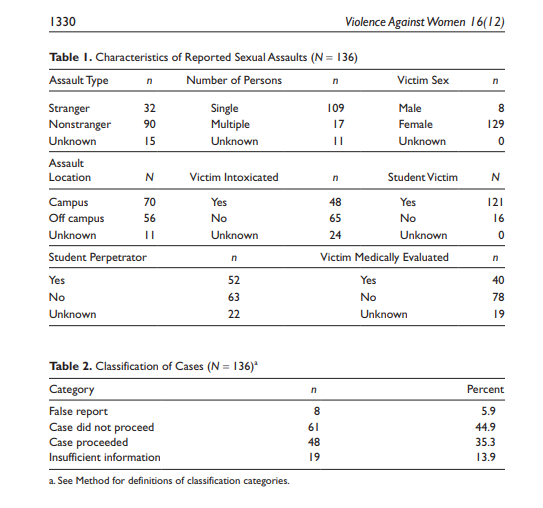

So let’s dispel with a lot of these myths, shall we? As much as 90% of campus rapes are unreported by the victims. That number improves to around 60% in society at large. This isn’t an issue where only women are assaulted sexually, because men are being raped as well and the numbers of those assaults are growing fast. And even if you take the highest percentage of false allegations, at most you’re looking at 6%. Brenda Tracy is well aware of the spectrum of assaults beyond men raping women too:
Please note I’ve been speaking in terms of men and women, but let me be clear, Sexual violence does not discriminate. Anyone can be a victim. This is a human issue. These are crimes committed against humanity and the saddest part is its all preventable. Marginalized and vulnerable communities of people experience higher rates of assault.
After all this, I think we can all agree that the numbers not only don’t lie but are remarkably consistent. So now we need to decide logically if 94 legitimate rape victims should be ignored because of the 6 who lied about being assaulted?

Brenda Tracy nails this argument to the wall swiftly.
The take away from the research is to believe survivors. And let me add that false reports for rape are no higher than false reports for other crimes. People lie. We all know this, but we only care when it comes to sexual assault. If one person lied about getting robbed society would never say ‘now we can’t believe the other 99% of people who report being robbed because of that one report. 
That means that we, as part of the Tennessee community, need to determine why the DA’s office miscalculated a criminal case so badly that they dragged the proceedings on for almost four years? How could they have proceeded with these indictments for that long when they knew the alleged victims’ and witness testimony wasn’t going to match up with the allegations? 

Defense attorneys David Eldridge and Stephen Ross Johnson — in the face of the prosecution’s lack of forensic evidence, conflicting or changed testimony from the accuser and witnesses on the stand, and the fact that both accusers deleted their social media and texts and then ditched their cell phones within a day of each other a few weeks before Johnson and Williams were indicted — put forth the opinion that the prosecution of such a flawed case was the result of a conspiracy because the accused were Tennessee football players.

Last week, that seemed like hyperbole but today that’s kind of difficult to argue against, isn’t it?
But, perhaps we should argue with that conspiracy theory. I’m not a fan of conspiracy theories or flat earthers or tin foil hats anyway, so let’s do a little more shredding of this case. 

It was just a little over two years ago that the University of Tennessee settled the Title IX case alleging a “rape culture” for such things as the kinds of sound bytes used during game and the music played by the DJ. Because…you know…Lil Jon. That case included the two accusers in Johnson and Williams’s criminal case as plaintiffs. You can read the accusers’ allegations specifically in the Title IX lawsuit here, beginning on page 27.

What really struck me about Jane Doe IV’s statements included within the lawsuit at the time was a comment about “whose side they were on”, meaning the university. 

Side? Nothing could demonstrate the he said/she said nature of this case any more clearly than that statement. Now that comment seems really odd in the face of what Johnson and Williams endured and will always endure as the result of this case. 

The fact of the matter is that we will never know the full extent of what happened at the party, but we can be absolutely certain that what the women alleged in the Title IX lawsuit — for which they received significant financial remuneration from the university in 2016 — is not what they stated on the witness stand during the rape trial this week. And while the jury may not be aware of that fact, it evidently didn’t matter. The accusers destroyed the prosecution’s case all by themselves because what they’d originally alleged and what they admitted to under oath in court last week were two different things. Brenda Tracy offered this thought on the verdict:
If the Tennessee case is a legitimate case of a false report then the system worked and those men were exonerated. What more as a society can we ask for than for the system to work? Does that mean any one deserves to go through that? No. Of course not, but there is nothing perfect in this world. People lie and people hurt other people. That’s why we have systems in place to prevent innocent people from going to jail. The response to this case, if it is a true false report, should be ‘good, the system worked’ not ‘all victims lie and we should disbelieve all survivors’. If the system is failing then you fix it, you don’t punish all victims of rape because a small percentage of people lie. If innocent people are being jailed and prosecuted then you fix the system — you don’t ignore, shame, invalidate, and dismiss survivors of rape.
Bolding mine. 

In a society where allegations of sexual assault committed by athletes have become almost commonplace, what happened last week in Knoxville could be a massive blow to legitimate victims of rape and sexual assault. Now, whenever an athlete is accused of sexual misconduct, there’s a huge section of the athletic world that’s going to say, “She’s a liar, just like those women at Tennessee were” just like they used to say “she’s a liar, just like that woman with the Duke lacrosse team”.

And that’s not the case. 

See, you can’t have it both ways. You can’t accept that sexual assaults occurred at Baylor or Michigan State or Ohio State but fall back on the “she’s a liar” defense for players with teams you root for. The fact of the matter is that our society has an obligation to believe people who report being the victims of rape. For hundreds of years, the justice systems in this country and other nations have routinely used a ‘blame the victim’ defense strategy.

She/he was dressed provocatively. 
She/he was drunk. 
She/he wanted it. 
She/he is a slut. 
She/he enjoyed it. 

That legal strategy has only one real purpose: to keep real rapists out of jail. Instead of saying ‘I never touched her/him’ the perpetrator is saying ‘I never would have touched her if she hadn’t enticed me with her behavior. Yeah, I had sex with her but it was consensual because she is a slut.’
And it’s not like that ‘blame the victim’ mentality doesn’t go on anymore. It absolutely does, and Stanford swimmer Brock Turner’s case is a prime example. Turner found a girl passed out in a parking lot and — instead of calling 911 like a responsible citizen — decided a quickie was the right way to go. Regardless of whether you think he was guilty or not, he and his family (who coincidentally live where else but not-so-smart Ohio)launched a ‘blame the victim’ publicity and social media campaign in which they bemoaned the fact that Brock wouldn’t be able to eat steak on Fridays because of some stupid slut’s addiction to alcohol. 


Sexual outercourse? What in the heck is that? Apparently, it’s a form of sexual encounter that is comprised of “non-vaginal sex” or penetration of the vagina with anything but the penis. I guess in Turner’s world, non-consensual non-vaginal sex is somehow okay to do to a non-conscious person. Turner was presented as an all-American boy…an athlete whose father publicly reinforced the elitist entitlement Turner displayed with a letter on Facebook:
His life will never be the one that he dreamed about and worked so hard to achieve. That is a steep price to pay for 20 minutes of action out of his 20 plus years of life.
Boo hoo. 

Although sexual assaults happen on a daily basis at every college and university in the country, the only cases we hear about are the ones that are centered around college athletes. I asked Brenda Tracy why that is.
There is nothing bigger than sports in this country. When sexual assault happens, we don’t hear about the chess club President. We hear about the football player and the point guard. The athletes and those stories make the news. The stories we see in sports shape the attitudes and beliefs we have about victims and perpetrators — and its an ugly one mainly because society has decided that all athletes are heroes and we can’t believe our heroes would disappoint us in this way. It’s also a huge inconvenience for the sports fan. They don’t want a rape victim ruining their game. And if we believe that the athlete committed this crime then we would be obligated to do something. We would need to demand change and accountability, but it’s easier to blame the victim and place the onus on them so that we don’t have to do anything — and this way we can get back to cheering for our team and our sports hero.
Brenda’s remark is harsh, yes, but it’s also accurate. When I first heard about the allegations against AJ Johnson and Michael Williams, I got that sick feeling in my stomach…that oh no, not UT! Dangnabbit,there’s got to be something wrong with this story because this is the last thing Tennessee needs…

I wasn’t thinking about the victims or the athletes. I wasn’t thinking about the lives that had just been irrevocably changed, for good or ill. I was thinking about how that accusation was going to impact the football season, and how other fan bases would be dogging us online, and that just when I thought UT had reversed an ideology that made me ashamed of the athletic department in general a couple of guys got their drink on and ruined everything…

…or how some chick made a bad decision and decided to ruin the lives of two great athletes out of spite or greed. 

Yes, I went there. And so did you. Most of us in this current conversation moved on from that gut check fairly quickly. For me, the gut check came within the first hour. I was 100% okay with the university’s response to the indictments. Once the allegations went into the criminal system, UT absolutely made the right decision to suspend both players immediately — a lesson Dan Mullen and the Florida Gators need to learn, by the way. 

But there’s a sizable proportion of the fan base that did not move past that first reaction. A ‘blame the victim’ ideology is the fastest and cruelest knee-jerk response to any allegation made against the young men who wear Tennessee uniforms and represent every single person with a love for UT.

How different the Turner case ended up from the Johnson and Williamson case. There were eyewitnesses, other men who intervened and prevented Turner from doing even worse then kept him on the scene until the cops got there; the victim’s testimony never wavered; the physical trauma of Turner’s attempts at ‘sexual outercourse’ was documented properly. Turner was convicted and served 90 steakless days in jail. Johnson and Williamson were acquitted, and lost four years of their lives. If the accusers in the UT rape case did misrepresent what happened initially, we’ll never know for certain if that was intentional. We do know that Turner’s victim did not lie. So, it is fair for Turner’s victim to be disbelieved just because the women that accused Johnson and Williams were not believed by a jury? 

Of course not. 

There are currently 310 open Title IX investigations ongoing at US universities. That’s indicative of an epidemic, which is a problem we absolutely must address. Part of the price we pay for the enforcement of Title IX and the protection of victims of sexual assault has to be belief. We have to agree to believe without question any rape or assault allegation that arises. We owe that to the victims of sexual assault. We know the majority of rape cases are never reported. Why? 
Because of what Brock Turner’s accuser has had to face, including a relentless assault by the accuser and his family on her character and reputation.

If you’re looking at someone to be mad at regarding what happened to AJ Johnson and Michael Williams, the culprits are easy to find. 

Look at the court system, that dragged this case out for four years without resolution. 

Look at the DA’s office, who went ahead and prosecuted a case in which the material witnesses, the accusers, couldn’t keep their testimony consistent. \

Look at the attorneys who handled the Title IX lawsuit, for making sure their clients got paid despite the damage those false allegations wreaked upon AJ Johnson, Michael Williams, their futures, their prospects, and their families. 

These are the people at fault. These are the people to blame. 

For those of us who’ve watched this case from afar for four years, we need to come to a realistic understanding of the issues surrounding big time athletics. We can neither afford to disbelieve assault accusers nor rush to judgment and condemn the accused without due process. We have to understand that the university’s actions in this case are absolutely what needed to happen as well. UT’s immediate suspension of the players is precisely what the university had to do under the circumstances. Once the DA indicated that the players were being indicted for a crime, Tennessee had no other choice. 

But we also much hold the people who really profited from this fiasco responsible for their actions. I think there’s definitely reason to look at repercussions for multiple parties and especially those in the DA’s office. 

I would have to wonder as well what legal ramifications there might be for the accusers, who said one thing under oath during legal depositions in the Title IX suit and an entirely different thing under oath on the witness stand during the trial. If the difference is that extreme — which upon first glance it appears to be to a layman like myself — I would think there are avenues through the civil courts for Johnson and Williams to seek some kind of remuneration. 

So should there be legal and criminal ramifications for people who bring false charges of rape, domestic violence, and assault be? Well, lying under oath is perjury, which in the state of Tennessee is a Class A misdemeanor. That carries a jail sentence of 11 months and 29 days maximum and a fine up to $2500.

Maximum. 

That doesn’t seem right, does it? Not when set against four years of two young men’s lives, months of backlash against UT for the Title IX suit, tens of thousands of dollars used to prosecute the case, and two shares of the $2.48 millions UT shelled out to the Jane Does of the lawsuit. Sure, Johnson and Williams can file a civil suit against their accusers, but that’s probably not going to accomplish a lot. Not really. Perjury during a trial is rarely prosecuted, so there isn’t much of a chance that the legal system would step in. At the end of the day, four young adults walked away from the courtroom on Friday and were freed from the trauma of a four-year court case. 

But they’ll never be free of the lingering aftereffects. Because of the DA’s’ ineptitude, the accusers will be forever thought of as liars and the accused as having ‘gotten off’ on all charges brought against them but…

The stigma of having been accused of rape is inescapable.

This story is tragic on multiple levels, but it’s also a cautionary tale. Young athletes need to demonstrate strong decision-making skills before they initiate a sexual encounter with anyone. Here’s a big hint — a party with lots of alcohol is probably not the right place for that kind of fun. For poor judgment, at least, AJ and Michael have to own up to their own responsibility. That one night of “fun” ruined almost everything for them. Young women need to make good decisions as well. The same advice I just gave the athletes works for them too — don’t have sex with a guy you don’t know at a party because you’ve been drinking. Just don’t. Save everyone involved the grief that follows.

Brenda Tracy is a person who understands, probably better than anyone in my acquaintance, of how to deal with the conversation that all of us need to be involved in. She travels the country, speaking to athletes in high school and college about sexual assault and its ramifications. Her #SetTheExpectation campaign educates young men and women all over the country, including downloadable pledges for athletes to commit to upholding — setting the expectations for the teams in simple terms. Athletes sign the pledge, acknowledging that if they break any of the commitments against sexual violence, they will be dismissed from the team. And their coaches sign the pledge as well, committing themselves to dismissing any athlete, no matter who, from the team if they violate that pledge. #SetTheExpectation does exactly that, and binds athletes and coaches alike to a code of behavior. 

As for the rest of us, we need to continue this conversation. We need to expand it, to develop it, to wowrk together assertively to change the trend toward sexual violence in our society. We need to teach our kids to make better decisions, athletes and non-athletes alike. And we need to make sure that no one is afraid to report sexual violence against them to authorities. 

That's our responsibility to the generations that follow us. Best get started, folks, because this is a Herculean task.

Saturday, February 04, 2017

Baylor Rape Scandal for Blogcritics--Part Five

(This is the fifth article in a five part series analyzing athletes, universities, and crime. The primary focus of the series is the ongoing revelations from the rape scandal at Baylor University and was originally published at Blogcritics Magazine on February 4, 2017. I anticipate further articles will follow up this one.)

Welcome to NCAA: Fact or Fanatic, where we’ve reached the final installment of our analysis of athletes’ criminal behavior and the culpability that ensues. Once again, Texas attorney Kevin Lindstrom (who also writes for GigEmGazette.com) and Texas-based Laura Leigh Majer, special contributor to NFLFemale.com and Down and Dirty Sports, weigh in on the issues.
Today, we’ll be taking a look at the fans’ part in the growing problem of student-athletes and crime, focused upon Baylor University and other schools with ongoing sexual assault issues.  One of the best places to gather information about how fans feel is The Paul Finebaum Show, a popular sports call-in show on the SEC Network, where on Monday the following occurred:
A Baylor fan from Dallas called the show to claim that “due process” has to play out in the Baylor rape allegations that blew up exponentially over the weekend, and that “it’s not fair” to the athletes or the program to be “punished further” since the president, athletic director, head football coach, and entire assistant coaching staff are no longer employed by the university.
That statement right there is exactly what’s wrong with college football, encapsulated in one fan’s opinion. The fans are what drive college athletics – dollars, attendance, boosters, alumni, gear, tickets, post-season play, online footprint. All of it is fan-generated and fan-driven. The sad fact is that to the average Joe and Jill Q. Public, winning football and basketball games is more important than the physical, emotional, and sexual health of a few anonymous females. And while Baylor University isn’t the only school with issues resulting from sexual assault, there can no longer be much question that it is the worst offender in a national problem.
And fans of the Baylor Bears are more concerned – still – about how fair play should happen for the program and its athletes.
You think this is exaggerated? Well, let’s take a look at the latest twist in the Baylor disaster.
A federal lawsuit filed Friday alleged that at least 31 football players at Baylor University committed at least 52 “acts of rape” over four years — including five gang rapes, two of which involved 10 or more players at the same time, some of whom videotaped the rapes on their phones and passed the recordings around to teammates.
The lawsuit, filed by a Virginia woman who alleges that she was gang-raped by two Baylor players in 2013, is the latest fallout in a sexual-violence scandal that has embroiled the Baptist university in Waco, Tex., for more than a year.
Stop for a moment and let that sink in.
Yes, these are “just” allegations. But with videotaped evidence of gang rapes that involved 10 players or more at the same time, they won’t remain as “just” allegations for long. Just as in the case at the University of Minnesota we discussed a couple of columns ago, video, audio, and phone records are finite, easily subpoenaed, and easily found by people who know how technology works.
And that includes what coaches say and how.
The lawsuit describes a culture of sexual violence under former Baylor football coach Art Briles in which the school implemented a “show ’em a good time” policy that “used sex to sell” the football program to recruits. That included escorting underage recruits to strip clubs and arranging women to have sex with prospective players, the suit alleges. Former assistant coach Kendal Briles — the son of the head coach — once told a Dallas-area student athlete, “Do you like white women? Because we have a lot of them at Baylor and they love football players,” according to the suit.
We had to read that four or five times before it sank in, really. Throughout the multiple universities named in Title IX lawsuits over the past five years has been a key phrase: “culture of rape.” The Title IX suit that the University of Tennessee settled in 2016 accused the school of establishing a “culture of rape,” but the UT cases involved athletes who were immediately deprived of their student-athlete privileges and removed from the team within hours of the allegations being made.
Baylor is different. At Baylor, athletes were protected by the coaches, police, and administration from facing punishment for sexual assault. At Baylor, victims were threatened into silence in order to keep that football program winning. At Baylor, everyone from the board of regents to the athletic director to university officials and police have undoubtedly contributed to what we may absolutely call, in all honesty, a “culture of rape.”
Oh, and let’s be for real here: The fans are guilty of that too.
For any normal adult human being, the idea that the major consideration in a case like this should be for the athletes and the program is incomprehensible. The fact of the matter is that at Baylor, all of the actions taken by the university were for the protection of itself, its program, and its athletes. Not the victims. Not the women who were gang-raped by 10 or more athletes who’d been conditioned to think it was okay because the coaches told them “we have a lot of women and they love football players.”
The victims, on the other hand, were told their parents would be informed of their illicit behavior. You know – drinking, drugs, and promiscuity.
So tell us, Baylor fans. How is it that the athletes involved in these crimes require more consideration than the victims do?
In no way. It can’t be.
The fact of the matter is that fans are not only entitled to expect explanations from universities and the NCAA regarding athlete-involved crimes where a student sexually assaults another student but we, as fans, must accept responsibility for our own part in creating an atmosphere on college campuses across the country in which injustice, torture, and persecution are acceptable as long as the team keeps on winning.
As usual, Lindstrom and Majer bring a sharp focus onto the real issues buried within the larger story. Majer weighs in on the role that football fans play in the dilemma that’s exemplified at Baylor:
The money a winning football team brings to a school also attracts alumni donations. It’s a loop of sorts: give to the team, win big, get money back to school. If covering up for a star player leads to more wins, which could turn into dollars, a program might be tempted to cover up for a player’s misdeeds.
This is borne out by Baylor’s rise to prominence as a football program. Disgraced head coach Art Briles was hired on the heels of a 3-9 2007 record under former head coach Guy Morriss. Under Briles’s “show ’em a good time” recruiting philosophy, the program thrived, as evidenced by their W-L record during his tenure.
Still not convinced?
The plans to build a new stadium began in 2011, when Robert Griffin III won the Heisman Trophy.
In July 2012, Baylor’s board of regents approved the building of the new, state-of-the-art McLane stadium. The stadium was ready for the season opener on August 31, 2014 at a cost of $266 million dollars – dollars that had been raised since Briles became the head coach.
You read that correctly. Baylor raised over a quarter of a billion dollars and built a brand new stadium from the ground up in three years. Three. Years. From 2011-2014, right?
Friday’s new lawsuit, remember, alleges 52 rapes committed by 31 football players from 2011-2014.
Every dollar spent on McLane Stadium was blood money, handed over by donors, boosters, alumni and the state of Texas to a university that was busily threatening, punishing, and marginalizing rape victims while issuing self-congratulatory reports about its purpose as exemplified by its mission statement:
The mission of Baylor University is to educate men and women for worldwide leadership and service by integrating academic excellence and Christian commitment within a caring community.
And while it would be devastatingly simple to break down that mission statement word by word, the sorry fact of the matter is that we don’t have to. This mission statement is a bunch of words, jumbled together and spewed out as rote. We don’t have to break it down because Baylor has proven that every single word is categorically and emphatically the direct opposite of what Baylor actually does. And while some fans, like the Finebaum caller we mentioned earlier, may think that since the erstwhile president, athletic director, head football coach, and all the assistant football coaches are gone Baylor has been punished enough, that’s really not the case.
Unfortunately, convincing Baylor fans of the necessity for further penalties appears to be a lost cause. Surprisingly, Baylor fans are continuing to stand by Art Briles, with some boosters and alumni spending thousands of dollars to “protest” his dismissal. Briles, astonishingly, is suing Baylor for his firing. And as more victims come forward and the sheer scale of the program’s horrific actions continues to grow, the definition of a “culture of rape” is shockingly, unbelievably clear.
culture of rape (phrase) – 1. a sociological concept used to describe a setting in which rape is pervasive and normalized due to societal attitudes about gender and sexuality 2. Baylor University
Come on down to Baylor! We’ve got lots of women and they love football players.
There you go, folks. A bona fide, in your face, without-a-shred-of-morality culture of rape.
But here’s where we need to begin drawing the line – not just at Baylor, but at the universities of which we are fans, alumni, or (in the case of our home state schools) supporters via our tax dollars. As fans, we hold the ultimate trump card and that’s the almighty dollar, as Lindstrom remarked:
Fans as the ultimate consumers can speak with their dollars. Anybody who makes a conscious choice to give money to universities to watch these athletes [is] contributing.
Which is absolutely true. Majer expanded with another serious consideration:
Fans, especially student fans, need to see some kind of punishment for athletes who commit crimes. I cannot imagine being a victim of a star player and having to see him get all kinds of attention from the fans and the media every week.
So the problem isn’t as simple as he said/she said. The issues that are driving the catastrophic rise of student-athletes committing crimes, and particularly sexual assault, are entrenched. They are also not new. Enabling criminal activity has been a part of college football culture for decades. Fans expect wins, and they demand the coaches provide those wins regardless of the cost. Universities rely upon the college football cash cow, and the NCAA does as well. Players are shown as recruits that their personal behavior isn’t a priority for those win-starved coaches, and then undertake criminal activity because they are confident the coaches and the university will either enable those activities or genuinely obstruct any attempts to discipline the player. The administrations are counting on the NCAA not getting overly involved in student-athlete crimes, although they’re paranoid about breakfast buffets and photo ops during official visits by top recruits. And the NCAA believes it is answerable to whom?
Nobody.
But that’s not the case, according to Lindstrom.
At the very least, fans have a right to expect the NCAA to not cover up or actively support anyone who is involved in criminal activity. The question comes in with how much they should get involved when schools dropped the ball. Baylor is a clear example of this. Especially because we’re talking about student-athlete on student violence, it absolutely is in the purview of the NCAA. This is not the Penn State situation.
What it boils down to is this: There’s a serious problem in this country and has been for some time. Athletes at the collegiate and pro levels support and subsidize a system that enables their criminal behavior in return. Not all schools do this. Most athletes never commit any offense worse than a speeding ticket. Not all coaches enable their players by overlooking their actions.
But those programs, those coaches, those players who do are operating within a back-scratching good-ole-boy-network mentality that football fans, boosters, and alumni willfully ignore because all they care about is the win. They reward those wins with dollars, and those dollars reinforce the system that is turning a blind eye to all these behaviors.
And then when a young woman is gang-raped in Minnesota by football players while a recruit participates and onlookers text and video the event, or another woman is raped by two football players at Baylor and that event is videotaped and passed around to teammates who were told by a coach during recruiting to come to Baylor because they have lots of women and they love football players, or an unconscious woman is found by a Stanford athlete who rapes her in a parking lot instead of calling emergency services – what’s the first thing you hear from fans?
And that, fellow football fans, is no one’s fault but our own.
The one absolute in cases like these is simple, but overlooked: All college students are entitled to a safe, healthy campus where they will not be preyed upon by their fellow students. Everyone from the NCAA down to the fan is obligated socially, morally, and legally to ensure the safety of every single student. If we, as fans, are to demand that the NCAA, universities, and programs guarantee that one absolute, the system we have in place now must be overhauled in its entirety. And we, too, must take a good, hard look at ourselves. By participating financially with the toxic programs discussed in this column, we are supporting the status quo.
That includes hiring coaches.
Since Briles was ejected from Baylor, the rumor mill has been grinding out a list of potential places the disgraced coach might land – both on the collegiate level and in the NFL. But with last week’s latest allegations, what does the future look like for Briles now?
Just when you thought it couldn’t get worse, on February 2, a series of damning text messages from Art Briles regarding victims exploded all over the internet.
When a female student-athlete reported that a football player had brandished a gun at her, the court paperwork said, Briles texted an assistant coach: “what a fool – she reporting to authorities.”
In another case, where a masseuse asked the team to discipline a player who reportedly exposed himself and asked for favors during a massage, the document said Briles’ first response was, “What kind of discipline…She a stripper?”
That, our friends, epitomizes what a “rape culture” is. That sloughing off of the real issues, blaming the victim, contemptuous laughter about the victim’s situation, is exactly what a rape culture is all about. Art Briles’s reaction to the atmosphere he himself had created in the Baylor football program is as much a rape of the victims as the actual assault was.
Interestingly, Briles dropped his wrongful termination suit against Baylor on the same day.
Even before these texts burst onto the internet just days ago, even before we worked them into an article already submitted to the editors as completed, Lindstrom’s opinion about Briles’s potential future in coaching was clear:
Throw in the new allegations that came out January 26th, it’s going to be a number of years before anybody even thinks about [Briles]. He was probably radioactive before today, but now it’s unimaginable. In fact, it’s going to be interesting to see what happens with his assistant coaches that went on to other schools. Back to Briles, never is a long time but on the other hand, he isn’t a spring chicken. There’s a good chance that by the time he rehabilitates himself, if that’s possible, there will be too many good young coaches that he just won’t get work.
Majer agrees.
After this latest report on rape allegations against Baylor (52 rapes over 4 years), I do not think Briles should ever coach again on a college level. He could probably go on an NFL staff in a minor role, but I think he has shown he has no business being anywhere near the college game. Given the most recent allegations, I am disappointed that coaches who were on his staff have been hired to other programs. Clearly, these men are not concerned about the conduct of their players as long as they win games. Coaches with this attitude do not belong on the college coaching level either.
We agree. Our responsibility as fans of the game is to ensure that the poisonous ideologies exemplified by Briles, his staff, and the University of Baylor are never accepted into other collegiate programs. Never.
And until fans do that? Baylor is only the tip of a very toxic iceberg.


Baylor Rape Scandal for Blogcritics--Part Four

(
This is the fourth article in a five part series analyzing athletes, universities, and crime. The primary focus of the series is the ongoing revelations from the rape scandal at Baylor University and was originally published at Blogcritics Magazine on January 12, 2017)

Welcome back to NCAA: Fact or Fanatic, where the season is over but the questions and problems remain. We’ve been taking a look at the staggering number of collegiate athletes who are committing crimes, and the universities’ responses. But there’s another entity we need to factor in here, and that’s the NCAA. How is it possible that the NCAA can cite a school for a violation because of a picture of the coach being too close to a recruit, but not weigh in at all on athletes committing crimes?
For an example, let’s go back to Baylor.
There isn’t a college football fan in the country who doesn’t know what went down at Baylor. New reports from women who were sexually assaulted continue to come out. The Pepper Hamilton report indicated that the university was involved in shaming victims who filed a report, threatening to tell their parents they’d been drinking or promiscuous, and in that manner kept their star athletes in school. The police department buried victims’ reports, thereby obstructing justice in these cases.
Through all this, the players continued to play, the seats in Baylor’s new stadium continued to be filled, and the university as well as the fans and alumni are unrepentant, defiantly pronouncing their support for disgraced and dismissed head coach Art Briles as Baylor kept the entire corps of assistant coaches on staff in 2016.
What do we hear from the NCAA?
Not a damn thing. And that’s the status quo regarding any athlete committing a crime. In December, 2016 17 college football and seven college basketball players were arrested or cited for crimes, according to Arrest Nation. Take a look at the schools involved:
Mississippi State University – 3 arrests/citations/charges
Ohio University – 3 arrests/citations/charges
Auburn University – 2 arrests/citations/charges
Florida State University – 2 arrests/citations/charges
Eastern Kentucky University – 1 arrest/citation/charge
Marian University – 1 arrest/citation/charge
Morehead State University – 1 arrest/citation/charge
Texas A&M University – 1 arrest/citation/charge
University of Arkansas – 1 arrest/citation/charge
University of Florida – 1 arrest/citation/charge
University of Houston – 1 arrest/citation/charge
University of Kansas – 1 arrest/citation/charge
University of Michigan – 1 arrest/citation/charge
University of South Carolina – 1 arrest/citation/charge
University of Tennessee at Chattanooga – 1 arrest/citation/charge
Utah State University – 1 arrest/citation/charge
Western Michigan University – 1 arrest/citation/charge
Youngstown State University – 1 arrest/citation/charge
But that’s just in one month. It doesn’t give you the true scope of the problem. Let’s take a look at Arrest Nation’s stats for 2016. First off, the top eight universities in athletes arrested or cited for crimes:
University of Missouri – 9 Arrests/Citations/Charges
Auburn University – 7 Arrests/Citations/Charges
University of Georgia – 7 Arrests/Citations/Charges
University of Nebraska – 7 Arrests/Citations/Charges
University of South Carolina – 7 Arrests/Citations/Charges
Mississippi State University – 6 Arrests/Citations/Charges
University of Colorado – 6 Arrests/Citations/Charges
University of Miami – 6 Arrests/Citations/Charges
University of Notre Dame – 6 Arrests/Citations/Charges
Washington State University – 6 Arrests/Citations/Charges
University of Florida – 5 Arrests/Citations/Charges
University of Illinois – 5 Arrests/Citations/Charges
University of Mississippi (Ole Miss) – 5 Arrests/Citations/Charges
University of North Dakota – 5 Arrests/Citations/Charges
University of Wyoming – 5 Arrests/Citations/Charges
Baylor University – 4 Arrests/Citations/Charges
Florida State University – 4 Arrests/Citations/Charges
Indiana University – 4 Arrests/Citations/Charges
Texas A&M University – 4 Arrests/Citations/Charges
University of Alabama – 4 Arrests/Citations/Charges
University of Iowa – 4 Arrests/Citations/Charges
University of North Texas – 4 Arrests/Citations/Charges
University of Oklahoma – 4 Arrests/Citations/Charges
University of Tennessee at Chattanooga – 4 Arrests/Citations/Charges
Youngstown State University – 4 Arrests/Citations/Charges
Arkansas State University – 3 Arrests/Citations/Charges
Coastal Carolina University – 3 Arrests/Citations/Charges
Illinois State University – 3 Arrests/Citations/Charges
Lindenwood University – 3 Arrests/Citations/Charges
Louisiana State University (LSU) – 3 Arrests/Citations/Charges
Ohio University – 3 Arrests/Citations/Charges
Purdue University – 3 Arrests/Citations/Charges
University of Arkansas – 3 Arrests/Citations/Charges
University of Hawaii – 3 Arrests/Citations/Charges
University of Kansas – 3 Arrests/Citations/Charges
University of Kentucky – 3 Arrests/Citations/Charges
University of Massachusetts – 3 Arrests/Citations/Charges
University of New Mexico – 3 Arrests/Citations/Charges
University of Tennessee at Martin – 3 Arrests/Citations/Charges
West Virginia University – 3 Arrests/Citations/Charges
Western Michigan University – 3 Arrests/Citations/Charges
Xavier University – 3 Arrests/Citations/Charges
Arizona State University – 2 Arrests/Citations/Charges
Bowling Green State University – 2 Arrests/Citations/Charges
Chapman University – 2 Arrests/Citations/Charges
Colorado State University – 2 Arrests/Citations/Charges
East Carolina University – 2 Arrests/Citations/Charges
Eastern Kentucky University – 2 Arrests/Citations/Charges
Georgia Institute of Technology (Georgia Tech) – 2 Arrests/Citations/Charges
Montana State University – 2 Arrests/Citations/Charges
Southern Utah University – 2 Arrests/Citations/Charges
Stony Brook University – 2 Arrests/Citations/Charges
University of Arizona – 2 Arrests/Citations/Charges
University of Connecticut – 2 Arrests/Citations/Charges
University of Maryland – 2 Arrests/Citations/Charges
University of Michigan – 2 Arrests/Citations/Charges
University of Nevada – 2 Arrests/Citations/Charges
University of Oregon – 2 Arrests/Citations/Charges
University of Southern California (USC) – 2 Arrests/Citations/Charges
University of Utah – 2 Arrests/Citations/Charges
Utah State University – 2 Arrests/Citations/Charges
Virginia Polytechnic Institute and State University (Virginia Tech) – 2 Arrests/Citations/Charges
Western Kentucky University – 2 Arrests/Citations/Charges
Boston College – 1 Arrest/Citation/Charge
Brigham Young University (BYU) – 1 Arrest/Citation/Charge
California State University, Fresno (Fresno State) – 1 Arrest/Citation/Charge
Central Michigan University – 1 Arrest/Citation/Charge
Clemson University – 1 Arrest/Citation/Charge
Cornell University – 1 Arrest/Citation/Charge
Eastern Washington University – 1 Arrest/Citation/Charge
Florida Institute of Technology – 1 Arrest/Citation/Charge
Gonzaga University – 1 Arrest/Citation/Charge
Grambling State University – 1 Arrest/Citation/Charge
Iowa State University – 1 Arrest/Citation/Charge
Jacksonville State University – 1 Arrest/Citation/Charge
Johns Hopkins University – 1 Arrest/Citation/Charge
Kent State University – 1 Arrest/Citation/Charge
Louisiana College – 1 Arrest/Citation/Charge

Marian University
 – 1 Arrest/Citation/ChargeLouisiana Tech University – 1 Arrest/Citation/Charge

Marshall University – 1 Arrest/Citation/Charge
Maryville College – 1 Arrest/Citation/Charge
Miami University – 1 Arrest/Citation/Charge
Michigan State University – 1 Arrest/Citation/Charge
Morehead State University – 1 Arrest/Citation/Charge
Morehouse College – 1 Arrest/Citation/Charge
Mt. San Antonio College – 1 Arrest/Citation/Charge
New Mexico State University – 1 Arrest/Citation/Charge
Ohio State University – 1 Arrest/Citation/Charge
Oklahoma State University – 1 Arrest/Citation/Charge
Penn State University – 1 Arrest/Citation/Charge
Portland State University – 1 Arrest/Citation/Charge
Shorter University – 1 Arrest/Citation/Charge
The Citadel – 1 Arrest/Citation/Charge
United States Military Academy (Army) – 1 Arrest/Citation/Charge
University of Akron – 1 Arrest/Citation/Charge
University of California, Davis (UC Davis) – 1 Arrest/Citation/Charge
University of California, Santa Barbara (UCSB) – 1 Arrest/Citation/Charge
University of Houston – 1 Arrest/Citation/Charge
University of Idaho – 1 Arrest/Citation/Charge
University of Maine – 1 Arrest/Citation/Charge
University of Minnesota – 1 Arrest/Citation/Charge
University of Missouri – 1 Arrest/Citation/Charge
University of Montana – 1 Arrest/Citation/Charge
University of North Alabama – 1 Arrest/Citation/Charge
University of North Carolina – 1 Arrest/Citation/Charge
University of Tennessee – 1 Arrest/Citation/Charge
University of Texas – 1 Arrest/Citation/Charge
University of Texas at El Paso (UTEP) – 1 Arrest/Citation/Charge
University of Texas at San Antonio – 1 Arrest/Citation/Charge
Washburn University – 1 Arrest/Citation/Charge
Wesleyan University – 1 Arrest/Citation/Charge

NCAA National Office, Indianapolis
The sports breakdown in these 273 incidents are as follows: college football, 203 arrests; basketball 57; baseball 4; lacrosse 2; soccer 2; track and field 2; gymnastics 1; softball 1; and volleyball 1.
Oh, and college coaches? Twelve arrests or citations. Twelve. Just let that simmer for a moment.
The scale of the problem is horrendous, and annually it keeps on growing. Keep in mind that, as we’ve previously discussed, only 1 in 10 sexual crimes are reported to police or the university. These stats also don’t count allegations that university doesn’t follow up on.
You’ll note that the worst offender is college football. But there’s another factor we need to consider. Not included in the stats above is another group that should concern us:
Former players.
In 2016, 97 former college football players were arrested or cited for crimes. Professional football had 33 arrests in 2016. How is that possible? These players got a full ride to their university. They didn’t shell out a single dime for an expensive education. Even if pro football didn’t pan out, they received an education.
Didn’t they?
Not necessarily. Right now, the University of North Carolina is under investigation by the NCAA for academic fraud perpetrated from 1993 to 2011. According to USA Today:
Wainstein’s report focused on courses in the formerly named African and Afro-American Studies (AFAM) department requiring only a research paper or two while offering GPA-boosting grades. Many were misidentified as lecture courses that didn’t meet.
Wainstein estimated more than 3,100 students were affected between 1993 and 2011, with athletes across numerous sports accounting for roughly half the enrollments.
That means more than 1500 student athletes got college credit and high grades for a course they never attended. One would have to be stupid to believe this sort of thing isn’t going on at other major universities. And this isn’t the first time something like this has happened.
Ever hear of Dr. Jan Kemp?
Kemp was a remedial studies professor at the University of Georgia in the early 1980s. You know – when Heisman Trophy winner Herschel Walker was there, and Georgia won a national championship. The academic situation was dire in the football program, and Kemp was the whistleblower who brought the whole process to a grinding halt. The university fired Kemp in 1982, after she refused to pass UGA football players in her classes if they hadn’t earned a passing grade.
According to an ESPN article by Tom Farrey:
Leroy Ervin, Kemp’s boss, was secretly taped at a faculty meeting. “I know for a fact that these kids would not be here if it were not for their utility to the institution,” he was caught saying in a staff meeting. “They are used as a kind of raw material in the production of some goods to be sold as whatever product, and they get nothing in return.”
Vince Dooley, at the time the Bulldogs’ coach and athletic director, testified that athletes were admitted with SAT scores of less than 650 out of a possible 1,600. “In order to be, we think, reasonably competitive, we thought that leeway was necessary,” he said at the time.
Kemp won her wrongful termination suit. She was reinstated at UGA, where she continued to teach remedial studies to college athletes until her death in 2008. Kemp’s reasons for speaking up about the UGA football program and its low academic standards was a benchmark moment.
“All over the country, athletes are used to produce revenue,” she told The New York Times a month after the trial. “I’ve seen what happens when the lights dim and the crowd fades. They’re left with nothing. I want that stopped.”
When you look at cases like these, and then consider the numbers of athletes who are charged with crimes, you have to start to wonder: What is going on in our universities? And why isn’t the NCAA doing anything about it?
The fact of the matter is that the NCAA hasn’t changed that much since the 1980s. Back then, in the UGA case:
Georgia would face no NCAA violations. The NCAA, an athletic body that usually lets schools determine if its own academic policies were violated, just was not interested in her information. Kemp recalls an NCAA investigator telling her, “We don’t want to hear anything about grades. All we’re interested in are cars, or trips, or things of that sort.”
She told him she hoped the university did give the athletes cars, since they weren’t getting an education.
So the NCAA had little interest in maintaining the academic integrity of college football programs as far back as the 1980s. But what are they doing now?
For that we need to look at another school: Penn State.
In the wake of the Jerry Sandusky scandal, the NCAA was driven to act. They forced Penn State to vacate 111 wins under Joe Paterno, pay a $60 million fine, and accept a bowl ban and scholarship reductions. The problem was that most of the sanctions were lifted. Why?
Because the NCAA was punishing people who had nothing to do with the abuse. Players. Fans. The game. Most of the sanctions were lifted because of the legality of the consent agreement the NCAA had forced Penn State to sign. Kansas State President Ken Schultz serves on the NCAA Board of Directors, and he stated:
“As the board of governors, we don’t have any desire to go in and have to do these sort of actions with any of our colleague institutions ever again,” he said. “This was a truly extraordinary circumstance and the board felt that they had to quickly and decisively put forward a set of sanctions … I hope it is a once-in-a-hundred-year type of occurrence and that we’ll be able to use the regular compliance activities” in future cases.
So what effect does this have on the Baylor case? Or Minnesota or North Carolina? Texas attorney Kevin Lindstrom weighed in.
…we have clearly gotten mixed signals from the NCAA over the past few years. Their actions in the Penn State matter may have an unfortunate chilling effect in situations such as Baylor where they absolutely should be aggressive.
Here is the key differences in the Baylor situation to the Penn State situation. In the Sandusky matter, it was a college employee assaulting children. While awful, I can see why people were critical of the NCAA for involving itself in such a matter that did not involve student athletes. Baylor, on the other hand, was student athletes committing crimes against other students and other student athletes. That screams jurisdiction for the NCAA.
The distinction he makes there is sound. Sandusky’s child abuse occurred in his off-season camps which, while they were held at Penn State facilities, did not involve or include student athletes. The NCAA sanctions against Penn State were a knee-jerk reaction to the horrified response throughout the athletic and academic worlds. And while the sanctions ultimately did a lot of good when that $60 million was distributed to organizations that lead the fight against child sexual abuse, the harm the NCAA inflicted upon student athletes at Penn State, who were innocent of any involvement in Sandusky’s crimes, was unjustified.
That brings us to Baylor. As Lindstrom points out, NCAA has direct jurisdiction here. These are student athletes who committed crimes, and the university administration, staff, coaches, and even the campus police colluded to keep those crimes from being prosecuted. As a result, victims were more than ignored. They were bullied into silence by individuals who are directly answerable to the NCAA. So here’s our question:
What, exactly, in the role of the NCAA in the Baylor case?
The National Collegiate Athletic Association has notified Baylor that it won’t exert its executive authority to impose sweeping sanctions against the school for broad institutional failings, and will instead follow its normal investigative process, according to people familiar with the matter.
Wait – what?
So although the NCAA self-identifies as having the authority to impose sanctions, it’s not going to? If this isn’t the type of case that falls directly under its jurisdiction, what is? Sure, it can stomp through the minutiae of Ole Miss’s recruiting records, imposing sanctions for feeding recruits breakfast or going to Hugh Freeze’s house. It can raise all kinds of hell about overnights in hotels or a coach’s behavior. But in a case like this involving student athletes, it’s not going to impose sanctions?
To be fair, the NCAA is looking into recruiting offenses by Baylor assistant Kendal Briles. Yes, that would be Art Briles’ son, who still worked at Baylor for the 2016 season. So what violation was so dire the NCAA could sanction Baylor when they refuse to do so in the sexual assault case?
According to the NCAA release, Briles and Wallis tried to find loophole in the rules that allowed them to see more prospects in the spring. This involved attending a recruit’s track meet and turning their backs when the recruit competed so it did not count as an official evaluation. The NCAA stated the two coaches attended the track meets during the spring of 2015 and were in a position to be seen by recruits. This put Baylor over the limit of two evaluations per prospect during the spring recruiting period.
Briles and Wallis were suspended for the 2015 season-opener against Lamar. According to ESPN, the violations were related to the recruitment of Sachse’s Devin Duvernay and Stafford’s Hezekiah Jones.
The NCAA has fined Baylor $5,000 because two assistants went to a track meet. In the meantime, fans have blacked out McLane Stadium in support of Art Briles, paid for full-page newspaper ads in support of Art Briles, and hung signs out of luxury boxes extolling Art Briles. And yet, the NCAA is silent.
Look, there are major problems with sexual assault on college campuses. While Title IX is intended to provide a system through which victims can seek recourse, Title IX coordinators are not law enforcement. The investigation and prosecution of athletes who are accused of crimes must go through proper legal means and due process. You can’t expect a university panel to legitimately determine which cases are important enough to discipline a player.
But in a case like Baylor, when the campus police are actively burying reports, you can’t even count on law enforcement to do what needs to be done.
On many college campuses, the university police are exemplary and genuinely investing in protecting all students.But on some – campuses where the win and the almighty dollar are the most important factors – the system breaks down. When that happens, it’s never in favor of the victims. Never.
That gap, between Title IX jurisdiction and the legal system, is what needs to be bridged. Title IX laws were designed to insure that both genders are treated equitably. In athletics, that means scholarships for both sexes must be equal, and athletes must have comparable privileges. Title IX is not designed to handle sexual assault allegations unless and until the victim has no other options.
If the victim reports the assault to the university and the university police and nothing is done, as at Baylor; if after she reports the assault she is bullied or threatened by the officials who are supposed to be protecting her, as at Baylor; then Title IX is the only option she has left.
That approach is not working. Lindstrom is able to speak authoritatively on this subject as well.
Well, first, we need to reevaluate Title IX’s role in investigating criminal issues between students. It seems that is putting someone who is often unqualified to know the details of something as complex as a rape case in an incredibly difficult position. Even for those who are in the business of investigating, prosecuting and trying rape cases have very difficult challenges, so how do we expect someone who has no experience with such matters to be able to address it fairly to the accused and accuser?
Excellent point.
In the end, it’s hard to escape the fact that the NCAA isn’t using the authority it already has in cases where it must be used. The same organization that gave SMU the death penalty for paying athletes to play, the same organization that punished football players for abuse that occurred without their knowledge or participation, is sitting on its thumbs regarding a case that’s far more severe than SMU’s and which falls directly under NCAA auspices, unlike at Penn State.
As Laura Leigh Majer, Texas sports journalist with NFLFemale.com and host of “Down and Dirty Sports” on AltConRadio, remarked:
When the schools are not disciplining bad behavior, especially criminal behavior, and it appears an institution is covering it up, it needs to be taken to the next level.
So we find ourselves in a conundrum. The NCAA isn’t doing anything in these cases – remember, the UNC academic fraud case has been ongoing without result or sanctions since 2012  – which emboldens the universities to not do anything either. Meanwhile, Title IX coordinators have offices that are woefully understaffed and underfinanced and sadly underqualified to pursue these cases or to impose any penalties outside of lawsuits. And that leaves victims like the ones in Baylor and Minnesota with nothing.
Apparently Ken Schultz and the rest of the NCAA governors are getting their wish. They have chosen not to act in this case. As a result, they have destroyed any respect the NCAA might have possessed as well as any trust. As for Baylor, it has additional problems. The Southern Association of Colleges and Schools’ Commission on Colleges has given the university a warning that its accreditation is in danger:
The commission found Baylor out of compliance with several accrediting requirements related to the sexual-assault scandal that has plagued the Baptist university in Texas, including a failure to provide adequate support services for students and a failure to have “appropriate fiscal and administrative control” of the institution’s athletics program.
Evidently, the SACS isn’t quite as intent upon non-action as the NCAA Board of Governors and Ken Schultz are.
Here’s the thing: In order to really make a difference in the world of college athletes and crime, there must be fundamental shifts of ideology at both the university and NCAA levels. Both must be willing to enforce penalties against student athletes who violate the law and the student code of conduct. When I was in college, if I’d been arrested for a violent crime against another student, what happened next would have been swift. I would have been arrested, charged, and tried for the crime. I would have lost my scholarship. I would not have been allowed to attend the university. And that would have been all she wrote, because at the end of the process I would most likely have served a sentence whose length depended on the degree of the crime. Period.
Same thing if my GPA exploded. If I pulled a 1.7 GPA for the semester because I decided to play video games in the football center instead of going to classes, my scholarship (communications and sports information, by the way) would have exploded as well.
Same for you, reading this column right now. Do you doubt it? Think for a moment. What breaks do non-athletes get when it comes to sexual assault?
None in the communications department. I was a debater. None of us on the team could have committed such an offense and been allowed to compete. Ever.
Texas sports journalist Laura Lee Majer’s answer to this question is direct.
The safety of all students on a campus should be a primary concern for a university.  No one should be above the law or given “special treatment” for being a star athlete if they break a law. I do not think universities are providing safe environments, and support for victims, overall.
We agree with her. What seems to be a point of contention, however, is when it’s the NCAA’s obligation to act. For that, Kevin Lindstrom has the correct answer, in our opinion:
I think it is an NCAA problem from the beginning. If we are talking about a student athlete, the NCAA needs to be kept appraised of it from the start. That transparency, while probably pretty burdensome on both the reporting school and the NCAA, would be essential to ensuring that something like Baylor can’t happen again.
So when will the NCAA act? Or will it continue to put it off like it has the UNC case? That’s the question that we, as taxpayers, alumni, and college sports fans need the NCAA to answer. Considering the NCAA is a tax-exempt organization that accrued revenue of nearly $1 billion in 2014, it is answerable for its decisions regarding cases under its jurisdiction. It might not think it’s responsible…it might not act like it is…
But it is.
We’ll wrap up this series next week with our final area of analysis: the fans. With college athletics generating so much revenue for everybody but the players, how much responsibility do football fans bear for the status quo? How do we impact colleges, players, coaches, or the NCAA? Why is the moral compass never pointing true north when it comes to athletes who commit crimes?
Some of the answers might surprise you.